

Why are you paying for clicks that go nowhere? If you're spending your marketing budget on ads only to see high bounce rates, your website is likely leaking revenue. You've probably asked yourself, "what is a landing page, and do I really need one if I already have a homepage?" It's a common point of confusion for local business owners who want results without the technical fluff. With Google's 2026 "Insufficient Original Content" policy now in full effect, sending traffic to a generic page isn't just ineffective; it's a liability for your digital presence.
We know how it feels to watch potential leads slip through the cracks while you focus on running your business. This guide clarifies exactly what a landing page is and why it's the most efficient tool for turning visitors into customers. You'll discover how the top 25% of pages achieve conversion rates over 11.45% by focusing on a single, clear objective. We will preview the essential design elements that build trust, explain how to comply with the latest 2026 privacy regulations, and show you how to implement high-performing pages that respect your visitors' time and your bottom line.
Key Takeaways
- Understand exactly what is a landing page and how it functions as a dedicated closing room for your digital marketing efforts.
- Learn why removing standard navigation menus is a strategic move that keeps visitors focused on your primary offer.
- Identify the essential elements of a high-converting layout, from the headline down to the final call to action.
- Distinguish between lead generation and click-through pages to select the right tool for your specific sales goals.
- Prioritize mobile-first design and page speed to satisfy both your visitors and the latest search engine requirements.
Defining the Landing Page: Your Business’s Most Focused Digital Asset
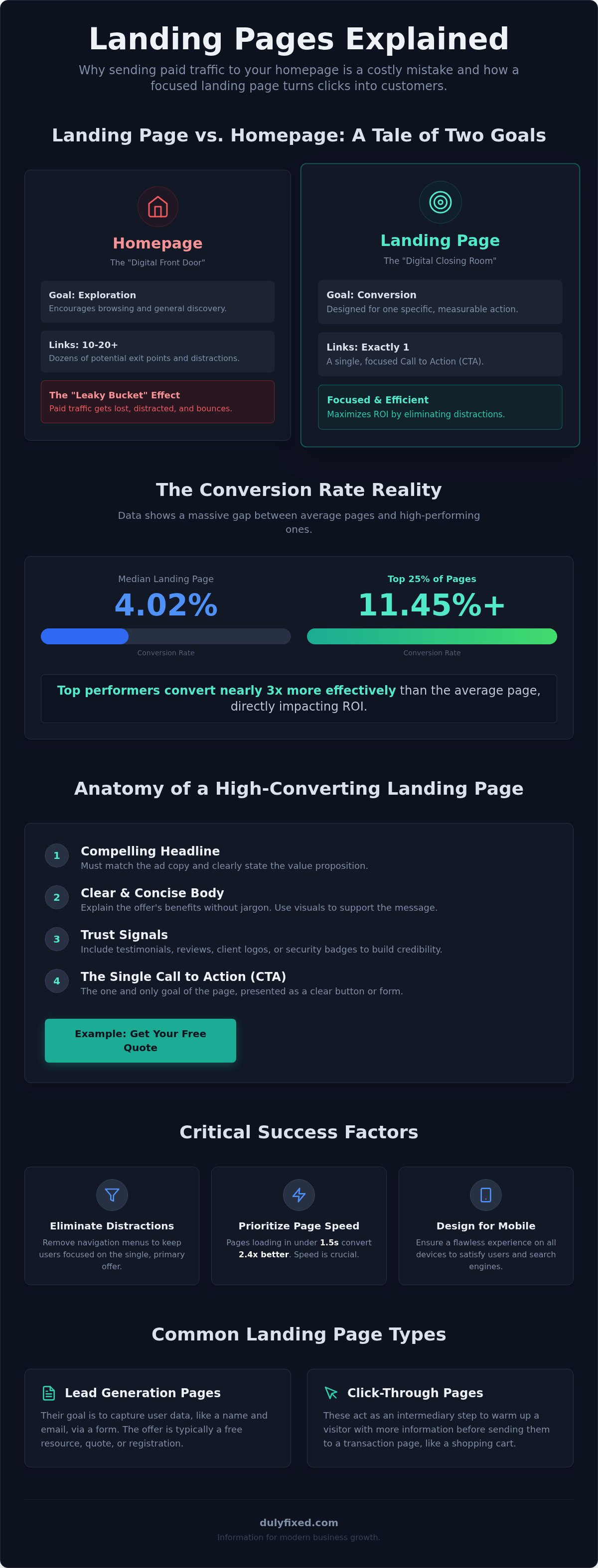
To understand what a landing page is, you must stop viewing your website as a digital brochure. Instead, think of it as a precision tool. A landing page is a single web page designed with one specific goal in mind. While your homepage is built for exploration, a landing page is built for results. It serves as the primary destination for your marketing efforts, such as search engine ads or targeted email campaigns. A landing page is a distraction-free destination built to convert traffic into a single, measurable action.
The most striking difference you'll notice is the lack of a header menu. Unlike a standard website, it removes navigation to keep visitors focused on a specific task. By cutting out the links to your "About Us" page or your latest blog post, you prevent the visitor from wandering away. You've paid for that click. You shouldn't give the user a reason to leave before they take action. This structure turns a simple web visit into a focused business transaction that respects the user's time.
The Philosophy of the 'Single Goal'
Giving a visitor too many options often results in them choosing none. This phenomenon, known as the Paradox of Choice, is a major conversion killer for small businesses. When a potential customer arrives from an ad, they have a specific intent. They're looking for a solution, not a history lesson on your company. There is a fundamental difference between "browsing" a site and "landing" on a solution. A single Call to Action (CTA) simplifies the customer journey by removing the mental load of deciding where to click next. It creates a straight path from the problem to your business, ensuring that your message and the user's needs are perfectly aligned.
How Landing Pages Drive Measurable ROI
When you evaluate what is a landing page for your business, the focus must be on data. Tracking the success of a homepage is notoriously difficult. Visitors bounce between pages, making it hard to tell which element actually triggered a sale. With a landing page, tracking is straightforward. Because there is only one goal, success is binary. This clarity allows you to calculate your Return on Investment (ROI) with surgical precision. By ensuring your page content matches your ad copy, you significantly lower your Cost Per Lead (CPL).
In the 2026 digital marketing landscape, this efficiency is vital. Data from Digital Applied in April 2026 shows that while the median conversion rate for landing pages is 4.02%, the top performers reach 11.45% or higher. These high-converting pages often feed directly into back-office automation systems. This ensures that once a lead is captured, your business responds instantly, maximizing the value of every dollar spent on traffic. It's about stability and tangible progress for your organization.
Landing Page vs. Homepage: Why Distraction is the Enemy of Sales
Think of your homepage as the digital front door to your business. It's welcoming, broad, and designed for exploration. In contrast, a landing page is a closing room. When you're trying to understand what is a landing page in a practical sense, look at the navigation menu. A typical homepage contains 10 to 20 links, including social media icons, "About Us" sections, and blog archives. If you send paid traffic there, you're essentially throwing money away. You've paid for a visitor to solve a specific problem, but you've handed them a map to your entire business history instead.
The difference in intent is clear. Homepages encourage exploration; landing pages demand action. This distinction is foundational to the role of landing pages in digital marketing. On a dedicated landing page, the number of links drops from dozens to exactly one. By removing the exit signs, you respect the visitor's time and keep them focused on the promise that made them click in the first place. This focused approach is the most efficient way to handle a specific marketing campaign.
The 'Leaky Bucket' Effect of Homepages
Sending ad traffic to a homepage creates a "leaky bucket" scenario. A visitor clicks an ad for a specific service, arrives at a general homepage, and immediately feels lost. They see social media icons and click away to check your Instagram. They see an "About Us" link and start reading your origin story. Every link is a potential exit point that distracts a ready-to-buy customer. There is a psychological shift from "curiosity" to "commitment" during the click. If the page they land on doesn't immediately mirror their intent, they bounce. According to 2026 industry data, pages that load in under 1.5 seconds convert 2.4 times better than those taking 4 seconds, and a busy homepage rarely meets that speed benchmark.
When to Use Which: A Strategic Framework
Strategic success requires knowing when to use each asset. Use your homepage for organic brand discovery, general information, and as a hub for returning customers. It's your permanent address. Use landing pages for Google Ads, Facebook campaigns, and local promotions where you have a specific offer. When you understand what is a landing page versus a standard site, you can stop the leaky bucket effect before it drains your budget. Dulyfixed Small Business Solutions builds SEO-ready site structures to balance both needs effectively. Your main site builds long-term authority, while your landing pages handle the high-intensity conversion work. This dual approach ensures your marketing budget isn't wasted on distracted visitors, providing the stability your small organization needs to grow.
The Anatomy of a High-Converting Landing Page
Understanding what is a landing page requires looking under the hood at the specific components that drive action. It's a conversion machine where every element has a job. If one part fails, the entire page loses efficiency. A successful layout starts with a headline that mirrors the exact ad copy or email link the visitor just clicked. This "message match" confirms they've arrived at the right place. Below the headline, a clear value proposition must answer the visitor's primary question: "What is in it for me?" without making them hunt for information.
Visual engagement is equally vital. High-quality images or professional Digital Video Production can demonstrate your service in seconds, which is often faster than text alone. To turn interest into action, you must provide trust signals. For small businesses in Soap Lake or Ephrata, this means displaying local Washington credentials, security badges, and authentic customer reviews. Finally, the page must feature a frictionless lead capture form. Research from April 2026 shows that forms with three fields convert approximately 25% better than those with nine fields. Keep it simple to keep them moving.
The Non-Negotiable: Mobile-First Design
In 2026, mobile-first design is the standard, not an option. With 86% of top-performing landing pages being mobile-friendly, your site must cater to users on the go in Seattle or Central Washington. Thumb-friendly buttons and vertical, single-column layouts are essential for usability. Performance is also a major factor. Pages that load in under 1.5 seconds convert 2.4 times better than those that take 4 seconds. This speed is critical for users on 5G or limited local networks who won't wait for a heavy, unoptimized page to load. Choosing Managed Web Hosting ensures your technical infrastructure supports these high-speed requirements.
Crafting a Call to Action (CTA) That Works
Your Call to Action is the most important element on the page. Avoid generic labels like "Submit" or "Click Here." Instead, use value-based language such as "Get My Free Quote" or "Start My Project." Use high color contrast and generous whitespace to make the button impossible to miss. The "One Rule" of landing pages is to have only one primary action per page. Don't confuse the visitor with multiple offers. A single, prominent button provides a clear path forward, turning a curious visitor into a tangible lead for your business.
Common Types of Landing Pages for Small Businesses
Choosing the right layout depends entirely on your specific campaign goal. When you evaluate what is a landing page for your unique business model, you'll find that one size rarely fits all. A local contractor needs a different approach than a retail shop or a professional consultant. Understanding these variations ensures you don't use a "warm-up" page when you should be asking for a lead. Here are the four primary types used by successful small organizations:
- Lead Generation (Squeeze) Pages: These focus on swapping value for contact information. You offer a resource, and the visitor provides their email or phone number in return.
- Click-Through Pages: These act as a bridge. They warm up the customer with benefits and social proof before they hit a "Buy" or "Sign Up" button on a separate page.
- Sales Pages: These use long-form content to explain high-ticket services or complex offers. They address every possible objection to move the visitor toward a major commitment.
- Splash Pages: These are simple, high-impact entries. They often handle age verification, language selection, or critical business announcements.
Lead Generation for Ephrata Service Pros
For service providers in Ephrata and Wenatchee, lead generation pages are the most effective way to build a local list. Using "Lead Magnets" like a free roof inspection checklist or an instant estimate tool gives visitors a reason to share their data. Because of the shifting privacy landscape in 2026, these pages must include clear privacy notices to comply with the 20 US state laws now in effect. By integrating Back-Office Automation provided by Dulyfixed Small Business Solutions, you can ensure that once a lead is captured, a follow-up text or email is sent instantly. This speed is what separates a successful local contractor from one who loses leads to the competition.
Video Landing Pages: The 2026 Engagement Standard
Digital video is no longer a luxury for landing pages; it's the 2026 engagement standard. Research from April 2026 shows that adding videos to a landing page positively impacts conversion rates for 39% of marketers. Video allows you to explain complex services in under 60 seconds, which is vital for busy users who won't read long blocks of text. It builds immediate trust by putting a face to your brand. Dulyfixed Small Business Solutions specializes in Landing Page Development that seamlessly integrates video to enhance your value proposition and keep visitors on the page longer. This modern approach ensures your message is heard, even if the visitor is just skimming the content on a mobile device.
Getting Started: Building a High-Speed Landing Page That Works
Launching a successful page requires moving from theory to execution. You now have a clear grasp of what is a landing page, but the final step is a disciplined rollout. Your first move is to isolate a specific audience segment and their primary pain point. Broad messaging fails because it lacks urgency. Once your target is clear, select a mobile-first layout that prioritizes functional speed over decorative elements. Write copy that speaks to the immediate relief your service provides, keeping the visitor moving toward the lead form you designed earlier. Your page is never truly finished; you must launch, monitor real visitor behavior, and iterate to improve results over time.
Building a high-speed asset is a technical challenge as much as a creative one. While we've discussed the anatomy of these pages, the underlying engine is what keeps them running. A high-converting page requires a stable environment where technical errors don't stand in the way of a customer's commitment. This is the difference between a page that looks good and one that consistently generates revenue. By following a structured implementation plan, you ensure that your marketing traffic is met with a professional, reliable destination every time.
Why Managed Hosting is Your Secret Conversion Weapon
Page speed is the silent killer of conversions, especially given the 1.5-second loading benchmark we discussed earlier. In the 2026 digital landscape, a slow page doesn't just frustrate users; it directly increases your bounce rates and wastes your ad spend. This is why Managed Web Hosting from Dulyfixed Small Business Solutions is a critical component of your strategy. It isn't just about keeping the site online; it's about providing the high-speed performance required to keep a mobile user engaged. Dedicated technical support ensures that your lead capture forms never break and your site stays secure against modern threats. Dulyfixed Small Business Solutions provides the stable infrastructure Central Washington businesses need to stay competitive and secure.
Partnering with a Local Washington Tech Expert
While DIY builders promise quick results, they often lead to technical debt and slow, unoptimized pages that fail current quality standards. Partnering with a local fixer who understands the specific Moses Lake, Soap Lake, and Seattle markets gives you a distinct advantage. You need a partner who can bridge the gap between complex digital tools and your practical business goals. When your marketing budget is on the line, investing in professional Landing Page Development ensures your closing room is built to the highest standards. Dulyfixed Small Business Solutions focuses on creating SEO-ready structures that turn traffic into tangible growth for your organization. Moving beyond the DIY approach allows you to focus on running your business while your digital assets handle the conversion work.
Stop Leaking Leads and Start Converting
We've moved beyond the basic definition of what is a landing page to see how it functions as a high-performance closing room for your business. You now know that removing distractions like navigation links and focusing on a single, value-based goal is the most efficient way to respect a visitor's time. By prioritizing mobile-first layouts and lightning-fast load speeds, you satisfy both your potential customers and the latest 2026 search engine standards.
Small businesses in Soap Lake and Moses Lake don't need complex, unmanaged DIY tools that create technical debt. You need stable, SEO-ready site structures backed by expert local support. Whether you're a contractor in Ephrata or a service provider in Wenatchee, your digital presence should be a reliable engine for growth rather than a source of technical headache. It's time to turn your marketing budget into a measurable return with a partner who understands the practical realities of running a local organization.
Maximize your growth with a mobile-first landing page from Dulyfixed.
Your business deserves a digital strategy that works as hard as you do. Let's get to work on building your next high-converting asset today.
Frequently Asked Questions
Is a landing page the same as a website?
No, a landing page is a single destination within your digital presence rather than a full website. While a website acts as a broad informational hub with many paths, a landing page is a standalone asset designed for one specific conversion goal. You use them to capture leads or drive sales for a campaign instead of providing a general company overview.
How much does a professional landing page cost for a small business?
The investment for professional landing page development depends on the technical complexity and specific goals of your project. Factors like custom video integration, back-office automation, and mobile-first design requirements all influence the final scope. It's best to consult with a technical partner to determine the requirements for a page that will deliver a stable return on your marketing spend.
Do I need a landing page if I don't run ads?
You still need focused pages even if you aren't currently paying for clicks. They are incredibly effective for email marketing campaigns, local social media promotions, and community outreach. Directing a potential customer to a specific solution rather than a broad homepage respects their time and increases the chances of a successful conversion.
Can a landing page have more than one goal?
A landing page should ideally focus on one primary action to maintain maximum efficiency. Offering too many choices creates mental friction and often results in the visitor leaving without doing anything. If you have multiple distinct services to offer, building separate pages for each ensures your message stays sharp and relevant to the user's intent.
How long should a landing page be?
The length of your page should match the complexity of your offer and the level of commitment you're asking for. Simple lead magnets like a free checklist can be very short; high-ticket services or complex technical solutions usually require more content. You must provide enough information to answer objections and build trust without adding unnecessary fluff that slows the reader down.
What is a good conversion rate for a landing page in 2026?
Benchmarks for what is a landing page success vary by industry, but current 2026 data provides a clear target. The median conversion rate across all industries is 4.02%, while the top 25% of performers achieve rates of 11.45% or higher. Focusing on mobile-first usability and page speeds under 1.5 seconds is the most reliable way to reach these higher tiers.
Do landing pages help with SEO in Soap Lake or Seattle?
Landing pages can significantly boost your local search presence when they are built with an SEO-ready site structure. By targeting specific regional keywords and user intent, these pages can rank for high-value local searches. They provide a relevant, high-speed experience for users in Moses Lake or Seattle while strengthening the overall authority of your business online.
Can I use a landing page as my main website?
You can certainly use a single, well-structured page as your primary website when you are first starting out. This "one-page" strategy is an efficient way to establish a professional presence while keeping your technical overhead low. When you understand exactly what is a landing page for your business, you can use it to prioritize lead generation from day one before expanding into a larger site later.
