

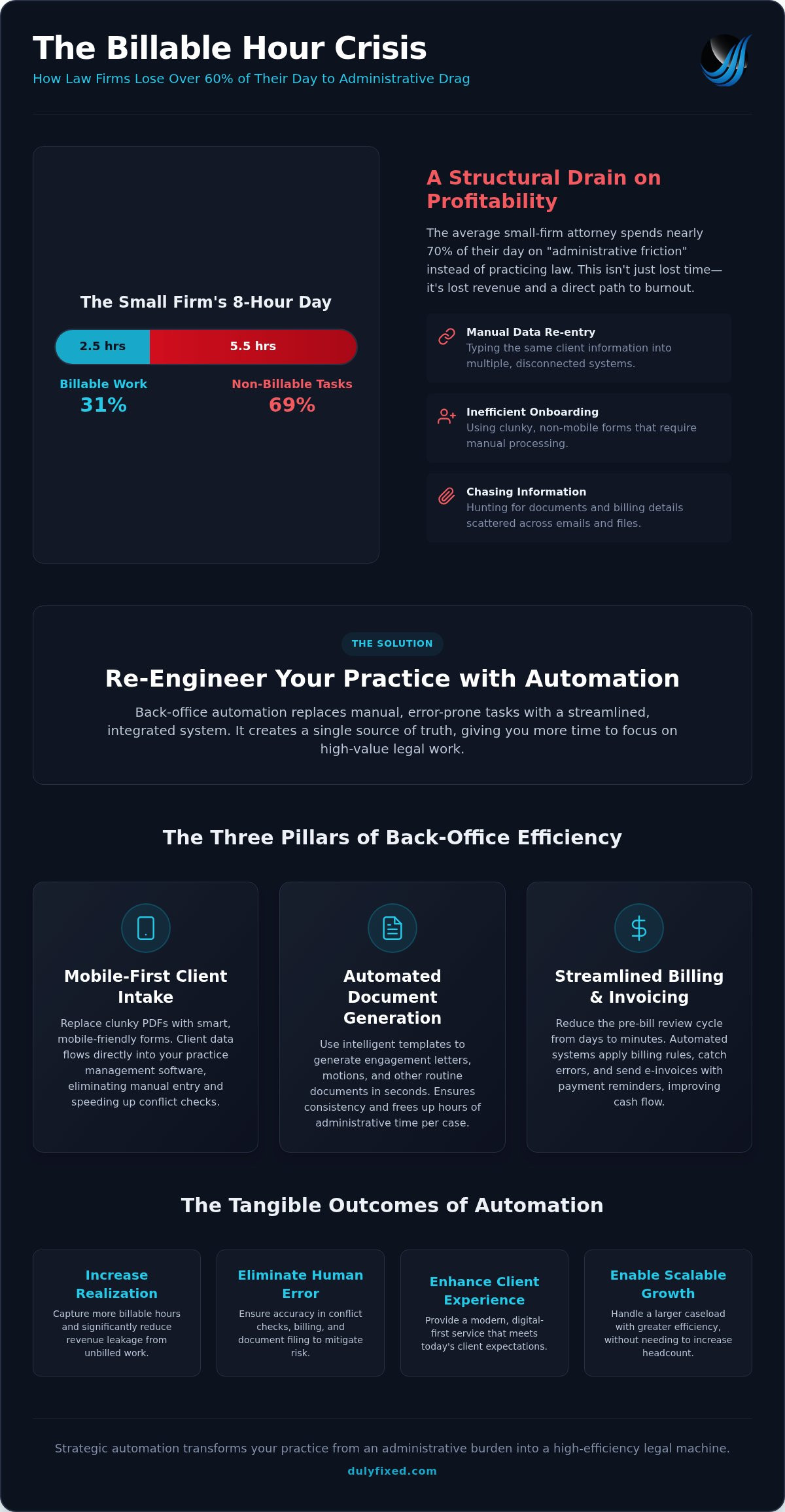
The 2026 Bloomberg Law Attorney Workload and Hours Survey reveals a startling gap: attorneys work an average of 49 hours per week but only bill for 37. If you're running a small firm, that friction is likely even worse. You might find that only 2.5 hours of your 8-hour day are actually billable. Much of that lost time is spent on manual tasks that back-office automation for law firms can handle in seconds. The rest of your day disappears into manual data entry, inconsistent client onboarding, and the constant hunt for missing billing information.
It's exhausting to feel like a high-priced administrator instead of a legal expert. We understand that your time is your most valuable asset, and every minute spent on non-billable tasks is revenue walking out the door. This guide shows you how to eliminate administrative drag and significantly increase your realization rates through strategic technology. At Dulyfixed Small Business Solutions, we help firms bridge this gap with tailored systems. We'll break down how to speed up client onboarding, fix billing errors before they happen, and use centralized dashboards to monitor your firm's health in real-time.
Key Takeaways
- Identify the specific "time-thieves" in your practice that currently limit small-firm attorneys to just 2.5 billable hours per day.
- Implement back-office automation for law firms to replace manual data entry with streamlined, mobile-first intake systems.
- Prioritize high-frequency, low-complexity tasks like scheduling and document templating to reclaim billable time immediately.
- Learn how integrated performance dashboards provide real-time insights into your firm's realization rates and profitability.
- Understand the pragmatic steps to "fixing" broken workflows without disrupting your existing legal practice or client service.
What is Back-Office Automation for Law Firms?
Back-office automation for law firms is the strategic use of integrated software to manage the repetitive, non-billable administrative tasks that keep a practice running. While front-office automation focuses on client-facing interactions like consultations and marketing, back-office systems handle the internal machinery. This includes everything from billing and conflict checks to document filing and data entry. It's the difference between how you present your firm to the public and how you actually operate behind the scenes.
The legal industry is currently facing a "Billable Hour Crisis." Industry data suggests that many attorneys spend over 60% of their workday on overhead and administrative friction rather than practicing law. This isn't just a minor inconvenience; it's a structural failure that drains firm profitability. By adopting modern Legal technology, firms can offload rules-based tasks to systems that work with perfect accuracy. In 2026, machine learning has advanced to the point where software can now recognize patterns in billing and drafting that previously required hours of manual review.
The Economic Impact of Administrative Friction
Every time a staff member manually re-types a client's information into multiple systems, your firm experiences "leakage." Administrative friction doesn't just waste time. It invites human error. A single typo during a conflict check or a failure to follow specific billing guidelines can result in rejected invoices or, worse, ethical complications. Automation creates a single source of truth where data flows seamlessly between tools without manual intervention. To ensure these systems remain reliable, savvy firms prioritize technical stability. For example, consistent website maintenance in Wenatchee and throughout the PNW helps prevent the operational downtime that can break automated intake and billing cycles.
Why 2026 is the Year of the Automated Law Firm
Client expectations have shifted toward instant, mobile-responsive communication. Today's clients don't want to print PDFs or wait days for a conflict check. They expect a digital-first experience that mirrors their interactions with other modern services. Furthermore, AI search engines like Perplexity and ChatGPT have changed how clients discover legal help, favoring firms with fast, structured data responses. A Legal Tech Stack is the foundational software architecture of a modern firm. Without this architecture, you're essentially trying to run a high-speed business on a manual engine. Automation allows you to meet these 2026 demands while actually reducing your personal workload.
The Three Pillars of Legal Back-Office Efficiency
Achieving true efficiency requires focusing on the specific areas that offer the highest return on investment. While every firm has unique needs, back-office automation for law firms generally centers on intake, document generation, and financial workflows. These pillars represent the points where manual friction most frequently causes billable leakage. Addressing these areas doesn't just save time; it builds a scalable foundation for growth that allows you to handle more cases without increasing your headcount.
Mobile-First Client Intake and Lead Management
Your intake process is often the first touchpoint a client has with your firm. If a potential client in Seattle or Wenatchee tries to fill out a clunky, non-responsive form on their smartphone, they'll likely move to a competitor. A mobile-first approach isn't just about aesthetics; it's about accessibility. By utilizing Professional Landing Page Design, you can capture leads through SEO-Ready structures that feed directly into your Legal Practice Management (LPM) software. This eliminates the need for staff to manually transfer data from an email into a matter file. These SEO-Ready structures are critical because they bridge the gap between marketing and operations. When your intake forms are optimized for search, they help AI search engines categorize your services accurately, creating a seamless path from a search result to a confirmed matter.
Automated Billing and E-Invoicing
Financial management is often the most time-consuming back-office task. Traditional pre-bill cycles, where attorneys manually review and edit draft invoices, can take days. Financial automation reduces this cycle to minutes by applying pre-set billing guidelines and logic-based checks. Automated systems also handle the follow-up. Instead of a staff member calling about an overdue bill, the system sends polite, automated reminders with a direct link to e-payment options. This improves cash flow without requiring additional administrative hours. If you're ready to see how these systems can transform your firm's profitability, talk to us about a workflow audit.
The final pillar is document automation. This involves using logic-based templates to generate standard filings, contracts, and letters in seconds. Instead of searching for the last good version of a document and using find and replace, staff enter specific variables into a form. The software then assembles the final document with perfect formatting. This ensures consistency across the firm and prevents the common errors associated with manual drafting. By automating these three pillars, you reclaim the hours lost to administrative drag and refocus your energy on high-value legal work.
Case Study: Streamlining a Washington State Legal Practice
Consider the experience of a two-partner firm in Moses Lake. Like many small practices in the PNW, they were drowning in administrative overhead. They were losing 15 hours every single week to manual billing and reconciliation. This wasn't just a loss of revenue. It was a primary source of burnout. By implementing back-office automation for law firms, they bridged the gap between their legacy files and modern cloud hosting. This transition allowed them to stop chasing data and start serving their community more effectively.
From Manual Entry to Automated Workflows
The overhaul began with their intake process. We replaced their outdated paper forms with a mobile-first intake site. Now, potential clients provide their information via smartphone before the first meeting. This data flows directly into their practice management system without a single keystroke from staff. To further streamline the process, the firm integrated digital video production to handle "Initial Consultation" FAQs. Instead of repeating the same foundational information to every new prospect, they use high-quality videos to set expectations and answer common questions early. This shift, paired with strategic Social Media Video Production, significantly improved lead quality. They stopped wasting time on unqualified leads and started focusing on high-value matters.
Measurable ROI: Beyond the Billable Hour
The results were immediate and transformative. Within the first 90 days, the firm saw a 40% increase in billable capacity. This didn't happen because they worked longer hours. It happened because they stopped doing "drudge work." Staff morale skyrocketed once the burden of manual data entry was removed. They could finally focus on the analytical work they were trained for. Client satisfaction metrics also improved. Because the system handled routine communication, the firm’s response times dropped from days to minutes. This speed led to a noticeable uptick in referrals from satisfied clients. Automation is the only investment that pays for itself by creating more time; the lawyer’s most finite resource.
If your firm is still relying on manual systems, you're likely leaving significant revenue on the table. The Moses Lake firm's success proves that back-office automation for law firms is accessible for small practices, not just large corporate entities. The key is to start with the most frequent bottlenecks and build out from there. When you remove the friction of manual operations, you don't just increase your profit; you improve the quality of your professional life.
How to Implement Automation Without Disrupting Your Practice
Successful back-office automation for law firms doesn't happen by flipping a switch. It's a methodical process that starts with a clear audit of your non-billable hours. You need to identify the specific "time-thieves" that drain your energy. For most practitioners, this means tracking exactly how many minutes are spent on scheduling, invoice follow-ups, and basic data entry. Once you have this data, you can prioritize tasks that are high-frequency but low-complexity. Automated appointment scheduling is often the best place to start because it offers immediate relief without risking complex legal workflows.
We recommend a phased rollout rather than a total system overhaul. Attempting to automate every department simultaneously is a recipe for operational gridlock. Instead, master one tool before moving to the next. This approach also helps secure buy-in from your paralegals and assistants. These team members are the primary users of these systems; if they don't trust the tool, the automation will fail. Involve them in the selection process to ensure the software actually solves their daily frustrations.
Building Your Legal Technology Stack
You'll likely face a choice between "all-in-one" platforms and a custom-integrated "best-of-breed" stack. While all-in-one software seems simpler, it often lacks the specialized depth needed for specific tasks like high-performance lead capture. Choosing tools with robust API integrations allows different systems to talk to each other seamlessly. This flexibility ensures your stack remains "SEO-Ready" as you grow. In 2026, security is non-negotiable. Any cloud-based back-office tool must offer end-to-end encryption and comply with Washington's strict data privacy standards to protect your firm and your clients.
Managing the Transition Period
Setting realistic timelines is essential for a busy Wenatchee office. A typical migration can take several weeks to fully optimize. One common pitfall is over-automating personal client touches. Automation should handle the "drudge work," not replace the empathetic counsel that defines your practice. Keep your personal communications human while the machines handle the filing. If you're worried about technical debt or broken integrations, don't go it alone. Our team provides dedicated Technical Support to ensure your migration is stable and results-oriented from day one.
Partnering with Dulyfixed for Law Firm Automation
Dulyfixed acts as the technical partner who understands that lawyers should spend their time in the courtroom or with clients, not troubleshooting software integrations. We bridge the gap between your legal expertise and the technical execution required for a modern practice. Our approach to back-office automation for law firms is pragmatic; we don't believe in technology for technology's sake. We focus on fixing the specific broken workflows that prevent you from reaching your full billable potential. By handling the "how" of automation, we allow you to focus entirely on the "law."
We specialize in integrating high-speed, mobile-first web design with back-end operational efficiency. This means your digital presence does more than just look professional. It serves as the primary engine for your firm's growth. When your front-end intake forms are perfectly synced with your back-office billing and document systems, you eliminate the manual hand-offs that lead to data errors and lost hours. It's about building a stable, long-term solution rather than applying temporary fixes to a fragmented system.
Why Local Expertise Matters for WA Law Firms
The business landscape in the Pacific Northwest is unique. Whether you're navigating the competitive market in Seattle or serving tight-knit communities in Wenatchee and Moses Lake, your operational needs differ from firms in other regions. We understand these local nuances because we're part of them. Dulyfixed provides a resourceful, local partner who combines SEO-Ready Site Structure with complex system integration. This ensures that your high-speed landing pages aren't just attracting leads but are actively feeding your automated back-end systems. We're "fixers" who understand the practical realities of running a small organization in Washington.
Take the Next Step Toward Efficiency
Modernizing your back office is a long-term investment in your firm's stability and your own quality of life. By reclaiming the hours lost to administrative drag, you increase your realization rates and create room for higher-value cases. The transition from "thinking about it" to "executing it" begins with a clear understanding of your current state. We start by identifying where your firm is leaking billable time and which automations will provide the fastest ROI. This audit is the first step in moving from a reactive practice to a proactive, automated firm.
Don't let manual processes cap your firm's growth. The tools available in 2026 make it easier than ever to build a resilient, efficient practice that serves both your clients and your bottom line. If you're ready to stop managing drudge work and start maximizing your legal expertise, let's talk about building a system that works for you. Reach out to the team at Dulyfixed to schedule your workflow consultation today.
Reclaiming Your Time for High-Value Practice
The shift toward back-office automation for law firms isn't just about software; it's about business survival in a competitive 2026 market. By addressing the "time-thieves" in your intake and billing cycles, you can move away from the administrative drag that currently caps your revenue. We've seen how local practices in Moses Lake and Wenatchee have transformed their operations by prioritizing mobile-first intake and seamless system integrations.
Success requires a partner who understands the technical debt small firms often carry. At Dulyfixed, we bring decades of real-world experience to every project. We specialize in building mobile-first, SEO-ready site architectures that serve as the foundation for your automated workflows. Based in Soap Lake, we provide the local Washington support you need to navigate these transitions safely.
The hours you reclaim today are the billable wins of tomorrow. It's time to stop managing spreadsheets and start focusing on your clients. Ready to reclaim your billable hours? Contact Dulyfixed for a custom automation audit.
Frequently Asked Questions
What are the first steps in law firm back-office automation?
The first step is conducting a thorough audit of your non-billable time to identify high-frequency, low-complexity tasks. Focus on areas like appointment scheduling or initial data entry where manual friction is highest. By documenting these time-thieves, you can prioritize automations that offer the fastest ROI. This data-driven approach ensures you aren't just buying software but solving specific operational bottlenecks that currently drain your firm's resources and focus.
Can automation really help a small firm with only one or two lawyers?
Small firms benefit significantly from back-office automation for law firms because they lack the administrative staff found in larger practices. Automation acts as a force multiplier, allowing a solo practitioner to handle the volume of a mid-sized office. By offloading routine tasks like invoice reminders to a system, you can focus your limited hours on high-value billable work rather than drowning in the paperwork required to keep the lights on.
Is back-office automation secure enough for sensitive legal data?
Modern automation tools are highly secure, utilizing end-to-end encryption and multi-factor authentication that often exceeds standard email protocols. Most reputable platforms comply with strict data privacy regulations, including Washington’s specific legal standards for client confidentiality. When choosing tools, look for SOC 2 Type II compliance and robust user access controls. These features ensure that your sensitive legal data remains protected while moving through your automated workflows without requiring manual oversight.
How much time can a law firm realistically save through automation?
Law firms can realistically reclaim between 10 to 15 hours per week by automating routine administrative cycles. Much of this time is recovered from the pre-bill process, conflict checking, and manual client intake. While the exact savings depend on your firm's current manual load, even basic scheduling automation can eliminate the back and forth emails that waste dozens of minutes per day. These reclaimed hours directly translate into increased billable capacity.
Does automation mean I have to replace my current legal software?
You don't necessarily have to replace your current legal software if it offers a robust API for integrations. Most back-office automation for law firms works by connecting your existing Practice Management Software with specialized tools for intake or billing. This approach allows you to keep the systems you know while adding modern efficiency. We focus on bridging the gaps between your current tools rather than forcing a total and disruptive system overhaul.
What is the difference between legal CRM and back-office automation?
A legal CRM focuses on managing relationships and tracking leads before they become clients, while back-office automation handles internal operational tasks once a matter is opened. While they overlap during intake, back-office systems are responsible for billing, document generation, and internal task management. Think of the CRM as your firm’s front-facing growth engine and back-office automation as the internal machinery that keeps your practice profitable, organized, and scalable.
How do I ensure my staff actually uses the new automated tools?
Ensuring staff adoption requires involving your paralegals and assistants in the software selection process early. They are the primary users of these tools, so the software must solve their specific frustrations to be effective. Provide clear training and demonstrate how the new system reduces their drudge work rather than adding to it. When staff see that automation makes their jobs easier and more accurate, buy-in happens naturally and quickly.
Can I automate client intake without losing the personal touch?
You can automate client intake without losing the personal touch by using technology to handle data collection while reserving human interaction for empathy and counsel. Automated systems can send personalized welcome videos or immediate confirmation messages that make clients feel heard instantly. This efficiency allows you to walk into the first consultation fully informed, so you can spend that time building a relationship instead of filling out basic paper forms.


