

Your customer's trust is far more fragile than your checkout process. A single security slip can undo years of brand building in a single afternoon. You likely already know that e-commerce website security is vital, but the technical jargon often makes it feel like an impossible mountain to climb. Between SSL certificates, PCI DSS 4.0 requirements, and server hardening, it's easy to feel overwhelmed by the complexity of staying safe online.
We understand that you want to focus on your products, not on fighting off digital intruders. This 2026 guide is designed to strip away the confusion and provide a clear, actionable plan to safeguard your store. You'll learn how to build a secure foundation that protects your customer data and supports your long term growth. We will walk through the essential security layers every shop owner needs, explaining why they matter and how managed services from Dulyfixed Small Business Solutions can take the technical weight off your shoulders.
Key Takeaways
- Understand why security is the hidden engine behind your conversion rate and how digital trust directly impacts your bottom line.
- Learn why managed web hosting is a superior investment over DIY options for small shops looking to offload technical maintenance and server hardening.
- Identify how to combat 2026-specific threats, including AI-driven phishing attempts that specifically target local business owners with realistic context.
- Implement a prioritized checklist for e-commerce website security to ensure your shop meets modern PCI DSS 4.0 standards and browser trust requirements.
- Discover how a local technical partner provides the managed support needed to keep your store secure while you focus on scaling your business.
What is E-commerce Website Security and Why Does it Matter?
Think of your online store as a physical storefront in downtown Seattle or Moses Lake. You wouldn't leave the front door wide open overnight without a security system in place. E-commerce website security is the digital version of that high end alarm system. It refers to the specific protocols and technologies designed to protect your shop from digital theft, data corruption, and unauthorized access. It's the invisible shield that keeps your business running while you sleep.
Security is the hidden engine behind your conversion rate. When a customer visits your site, they are subconsciously looking for signs of safety. If their browser displays a "Not Secure" warning, most shoppers will bounce immediately. This "Trust Factor" goes beyond just protecting credit card numbers. Modern security measures also safeguard customer identities, email addresses, and even their browsing habits. If you can't protect their privacy, you can't expect their loyalty.
Many local retailers believe they are too small to be targeted. This is a common mistake. Most cyberattacks are automated; bots crawl the web looking for specific technical vulnerabilities rather than high revenue targets. A small shop with outdated software is often a more attractive target for a hacker than a massive corporation with a dedicated security team. For businesses in Washington State, a single breach can be devastating to a reputation built over decades.
The Four Pillars of Online Security
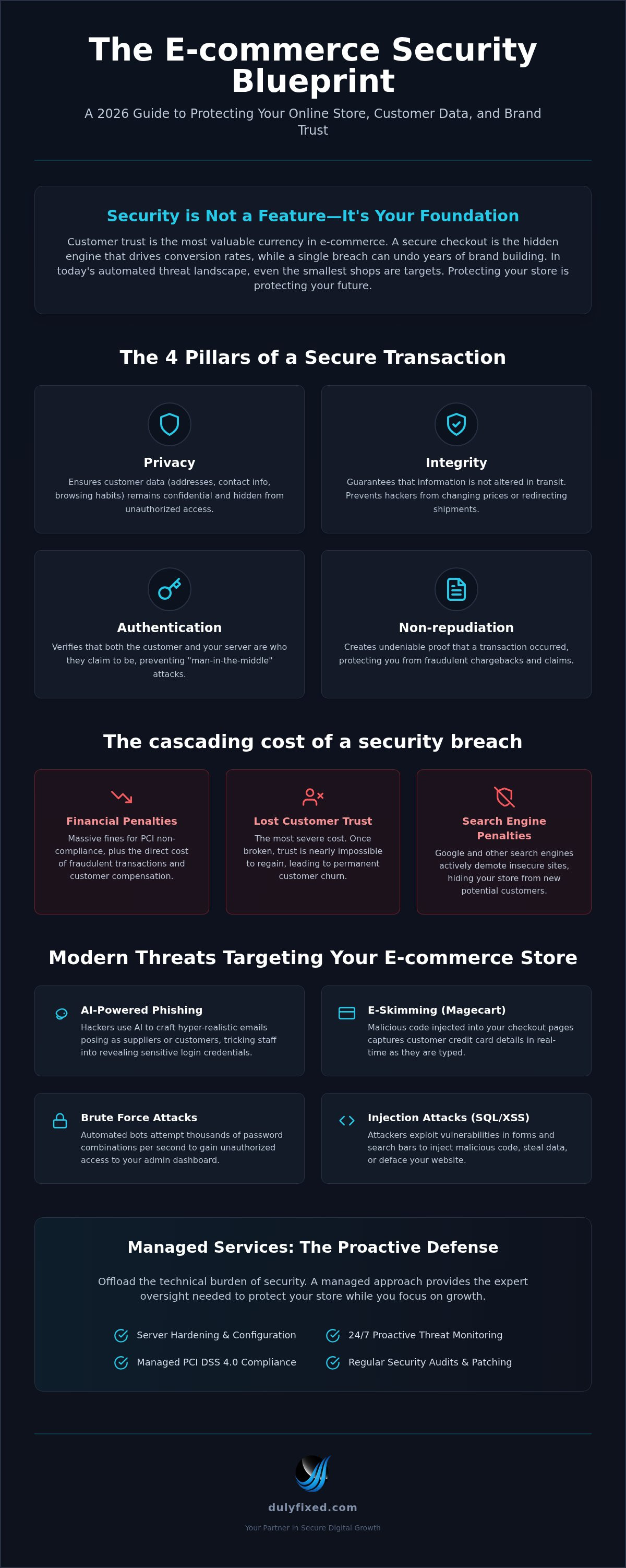
To truly understand how to protect your shop, you need to look at the four fundamental pillars that support a secure transaction:
- Privacy: This ensures that customer data, such as addresses and phone numbers, remains hidden from unauthorized eyes.
- Integrity: This guarantees that information hasn't been altered. For example, it prevents a hacker from changing the price of an item or the shipping address during the checkout process.
- Authentication: This verifies that both the user and the server are exactly who they claim to be, preventing "man-in-the-middle" attacks.
- Non-repudiation: This provides legal proof that a transaction actually occurred, protecting you from fraudulent "I never bought that" claims.
The Cost of a Breach for Local Retailers
The fallout from a security failure is rarely just a quick fix. Financial penalties for PCI non-compliance can be massive, but the hidden costs are often worse. Local customers are surprisingly unforgiving when it comes to data leaks. Once that trust is broken, it's nearly impossible to win back. Google and other search engines also actively penalize insecure sites. If your e-commerce website security isn't up to standard, your SEO rankings will drop, making it harder for new customers to find you. This is why Dulyfixed Small Business Solutions prioritizes SEO-ready site structures that include robust security as a foundational element, not an afterthought.
Modern Cyber Threats Facing Small E-commerce Shops
The digital threat landscape has shifted dramatically. By 2026, the tools available to hackers have become more sophisticated and automated. This means e-commerce website security is no longer a "set it and forget it" task. Small businesses are now facing proactive, AI-driven attacks that bypass traditional, static defenses. These threats aren't just aimed at the giants; they're designed to find the path of least resistance.
One of the most alarming trends is AI-powered phishing. Hackers use large language models to scrape local data from social media and news outlets in places like Soap Lake or Wenatchee. They create highly personalized emails that look like they're from a local supplier or a regular customer. These messages are nearly indistinguishable from legitimate communication, making it far easier for staff to accidentally click a malicious link or share login credentials.
Another invisible threat is e-skimming, often associated with groups like Magecart. Instead of a physical skimmer on a gas pump, these thieves inject malicious code directly into your digital checkout. It captures credit card details in real time as your customers type them. Maintaining modern e-commerce website security requires constant monitoring to catch these scripts before they do damage. Brute force attacks also remain a major issue. Automated scripts can try thousands of password combinations every second. If your admin login is still a simple variation of your business name, you're essentially leaving your vault wide open.
Injection Attacks and Cross-Site Scripting (XSS)
Your site's contact forms and search bars are potential entry points for injection attacks. In a SQL injection, a hacker enters malicious code into a form field to trick your database into revealing sensitive information. Cross-Site Scripting (XSS) is similar but targets your customers. It injects scripts into your pages that can steal session cookies or redirect users to fraudulent sites. Because mobile-first website design often relies on complex JavaScript, validating every script is vital to prevent these exploits from reaching your mobile shoppers.
The Rise of Botnets and Automated Scraping
Botnets are networks of compromised computers that can perform massive, automated tasks. For a small e-commerce shop, this often manifests as inventory scraping. Bots crawl your site to steal pricing data for competitors, which can slow your server to a crawl. Even worse is credential stuffing. Bots use lists of passwords leaked from other site breaches to try and hijack your customers' accounts. If you're seeing unusual login activity or server lag, it might be time to reach out for technical support to implement better bot mitigation strategies that won't hurt your SEO performance.
Managed Web Hosting: The Foundation of Secure Sales
Choosing a hosting provider based solely on the lowest price is a gamble that rarely pays off for online retailers. Cheap, unmanaged hosting is often the most expensive mistake a business owner can make. In these environments, you are responsible for every patch, update, and server configuration. If a vulnerability is discovered in the middle of the night, the burden of fixing it falls entirely on you. E-commerce website security starts at the server level; if the foundation is weak, the rest of your site is at risk regardless of how many plugins you install.
We think of effective protection as a "security sandwich." The bottom layer is the server environment, and the top layer is your specific e-commerce application. For these layers to work together, they need constant synchronization. Managed web hosting handles the heavy lifting of server hardening, ensuring that the software running your site is isolated from other users on the same hardware. This prevents a breach on a neighbor's site from spilling over into your store.
Automatic updates are your first line of defense against known vulnerabilities. Hackers love to exploit flaws in popular e-commerce platforms as soon as they are publicized. A managed environment ensures these patches are applied the moment they are released, often before you even realize a threat exists. At Dulyfixed Small Business Solutions, we integrate these security layers directly into our hosting environment. We handle the technical weight so you can focus on moving inventory rather than playing IT manager.
Server-Side Protections You Can't Ignore
Proactive defense requires tools that filter out trouble before it reaches your login page. We utilize several key technologies to keep your store running smoothly:
- Web Application Firewalls (WAF): These act as a digital filter, analyzing incoming traffic and blocking malicious requests like injection attempts.
- Intrusion Detection Systems (IDS): Think of these as digital security guards that monitor your server for suspicious patterns and alert us to potential threats in real time.
- Regular Backups: This is your ultimate safety net. We maintain redundant, off-site backups so that if the unthinkable happens, we can restore your store to a clean state in minutes.
Managed Technical Support in Wenatchee and Soap Lake
There is immense value in having a local "fixer" on call. When you run into a technical glitch or a security concern, you shouldn't have to wait in a generic support queue for hours. Our approach to managed support in Wenatchee and Soap Lake is built on proactive monitoring. We often catch and resolve threats before they ever reach your customers. This level of care is a core part of our Website Maintenance Wenatchee: The 2026 Small Business Checklist, ensuring your e-commerce website security remains a competitive advantage rather than a source of anxiety.
Your E-commerce Security Checklist: 5 Essential Steps
Securing your shop can feel like a never ending task list. To make it manageable, you need to prioritize actions that offer the highest level of protection for the least amount of friction. Effective e-commerce website security isn't about doing everything at once; it's about building layers that work together to frustrate attackers. By focusing on these five steps, you can move from a reactive state of anxiety to a proactive state of growth.
Step 1 & 2: Encryption and Authentication
By 2026, a basic SSL certificate is the bare minimum requirement. While standard encryption is mandatory, Extended Validation (EV) certificates provide a more visible trust signal by displaying your verified business name in the browser bar. This small detail can significantly reduce cart abandonment by proving you are a legitimate entity rather than a fly by night operation. It's a simple way to build brand equity while protecting data in transit.
Authentication is your next line of defense. Strong password policies are a start, but they are easily bypassed by modern phishing techniques. Multi-factor authentication (MFA) is a non-negotiable security layer for 2026 that ensures a stolen password isn't enough to compromise your store. Every admin account, from your marketing manager to your inventory lead, must have MFA enabled to prevent a single point of failure from bringing down the entire shop.
Step 3, 4, & 5: Compliance and Monitoring
PCI DSS 4.0 standards are the baseline for any store handling credit card data. The easiest way to stay compliant is to never touch the sensitive data yourself. By using PCI compliant payment gateways, you shift the liability and the technical burden to specialists. This ensures that even if your front end is targeted, your customers' financial details remain isolated and safe within a hardened vault.
You should also perform regular security audits. This means "hacking" your own site to find weak spots before a criminal does. Check your SEO-ready site structure for any unauthorized redirects or hidden pages. Malicious redirects are a favorite tool for hackers to steal your traffic and destroy your search rankings. If you aren't sure how to run these checks, contact our technical support team for a professional security review that keeps your store's foundation solid and your reputation intact.
Building a Secure Future with Dulyfixed Small Business Solutions
The 2026 digital landscape doesn't tolerate "good enough" for protection. As we've explored, e-commerce website security is a complex, moving target that requires constant attention. For small business owners in Washington State, trying to manage this alone is often a recipe for burnout. Our approach at Dulyfixed Small Business Solutions is built on being a pragmatic, reliable partner who understands that your time is better spent growing your brand than worrying about server logs.
From the quiet streets of Soap Lake to the competitive markets of Seattle and Wenatchee, we help Pacific Northwest businesses scale safely. We don't just build websites; we build secure foundations. This means integrating security into the very fabric of your site architecture from day one. By positioning ourselves as your technical partner, we take the heavy lifting of back-end maintenance off your plate. This allows you to focus on what you do best: selling your products and serving your community.
Our Managed Security Philosophy
We believe that security should be invisible to your customers but impenetrable to intruders. This philosophy drives our dedicated technical support. We monitor your environment in real time, applying patches and hardening servers before vulnerabilities can be exploited. This proactive stance is vital when integrating back-office automation. As you streamline your operations, we ensure that every automated process follows secure data practices to prevent leaks.
A mobile-first website design is often discussed in terms of aesthetics, but for us, it's also about secure performance. Mobile shoppers are frequently on less secure public networks, making script validation and encrypted data paths even more critical. We optimize your site to be fast and stable on any device. We ensure that security measures never slow down the user experience. Secure performance is the standard we set for every project we touch.
Get Started with a Technical Audit
If you're unsure where your store stands, the best first step is a professional review. We offer comprehensive technical audits to examine your current e-commerce hosting security and identify potential gaps in your defense. Whether you're dealing with slow load times, suspicious bot traffic, or just want the peace of mind that comes with expert oversight, we're here to help. We create customized plans that align with your specific growth goals and budget, ensuring you have a stable platform for years to come.
Don't wait for a breach to realize your shop is vulnerable. Take control of your digital future today by partnering with a team that values your store's integrity as much as you do. Contact Dulyfixed Small Business Solutions for a Secure Web Hosting Consultation and let's build a foundation that supports your long term success.
Secure Your Store for the Long Haul
Protecting your online shop requires moving beyond basic plugins to a managed technical foundation. By prioritizing multi-factor authentication and choosing PCI-compliant payment gateways, you safeguard both your revenue and your local reputation. Remember that e-commerce website security is about more than just data; it's the engine that drives customer trust and long term growth in the Washington market.
You don't have to carry the technical weight of your business alone. Dulyfixed provides pragmatic, expert-led security solutions through SEO-ready and mobile-first site structures tailored for PNW small businesses. We handle the server hardening and maintenance so you can stay focused on scaling your sales. Secure your store with Managed Hosting from Dulyfixed and build a digital presence that is as resilient as it is profitable. Your future growth starts with a stable foundation today.
Frequently Asked Questions
Is an SSL certificate enough to secure my e-commerce website?
No, an SSL certificate only encrypts data while it travels between the user's browser and your server. While it prevents "eavesdropping" on sensitive information, it does nothing to stop a hacker from exploiting a weak password or a vulnerability in your site's software. True e-commerce website security requires a multi-layered approach that includes server-side firewalls, regular software patches, and strong authentication protocols.
What is PCI compliance and does my small business really need it?
PCI DSS compliance is a set of security standards designed to ensure that all companies that accept, process, or store credit card information maintain a secure environment. Yes, your small business needs it regardless of your transaction volume. Failing to meet the 2026 PCI DSS 4.0 requirements can lead to heavy monthly fines from banks and the potential loss of your ability to process credit card payments entirely.
How often should I update my e-commerce site for security?
You should apply security updates the moment they are released. Hackers often use automated bots to scan for sites running outdated software with known vulnerabilities. If you wait even a few days to patch a critical flaw, you are leaving a window of opportunity open for an attack. Managed hosting services typically handle these updates for you, ensuring your store is always running the most secure version of its software.
Can a hacker get into my site through a simple contact form?
Yes, poorly coded contact forms are a common entry point for SQL injection and cross-site scripting (XSS) attacks. If your forms don't properly sanitize the data users enter, a hacker can submit malicious code that tricks your database into revealing sensitive information or grants them administrative access. Every form on your site must have robust validation and filtering to prevent these automated exploits.
What should I do if I think my e-commerce site has been breached?
Immediately isolate your site by taking it offline or into maintenance mode to stop further data loss. You should then change all administrative passwords, notify your hosting provider, and consult a professional "fixer" to identify the entry point and clean the malicious code. Don't delete your server logs, as these are vital for understanding how the breach happened and ensuring it doesn't happen again.
Does my web hosting choice actually affect my site's security?
Your hosting provider is the foundation of your entire security strategy. Budget shared hosting often lacks the server-level hardening and isolated environments necessary to prevent a breach on one site from affecting others on the same hardware. Choosing managed web hosting ensures you have dedicated resources and professional server management, which is the most effective way to improve your e-commerce website security from the ground up.
Is managed technical support worth the cost for a small shop?
Yes, because the cost of a single data breach or a week of downtime far exceeds the monthly investment in professional support. For a small shop in Wenatchee or Seattle, having an expert on call means you don't have to spend your time troubleshooting technical glitches or security alerts. It allows you to focus on your products and customers while a partner handles the complex back-end operations that keep your store stable.
How does e-commerce security impact my SEO rankings in 2026?
Google and other search engines prioritize the safety of their users and will actively penalize sites that show signs of malware or lack proper encryption. If your site is flagged for security issues, your rankings will drop, and browsers will display a "Not Secure" warning that scares away traffic. Maintaining a secure, SEO-ready site structure is essential if you want to remain visible in search results and build long term authority with your audience.


