

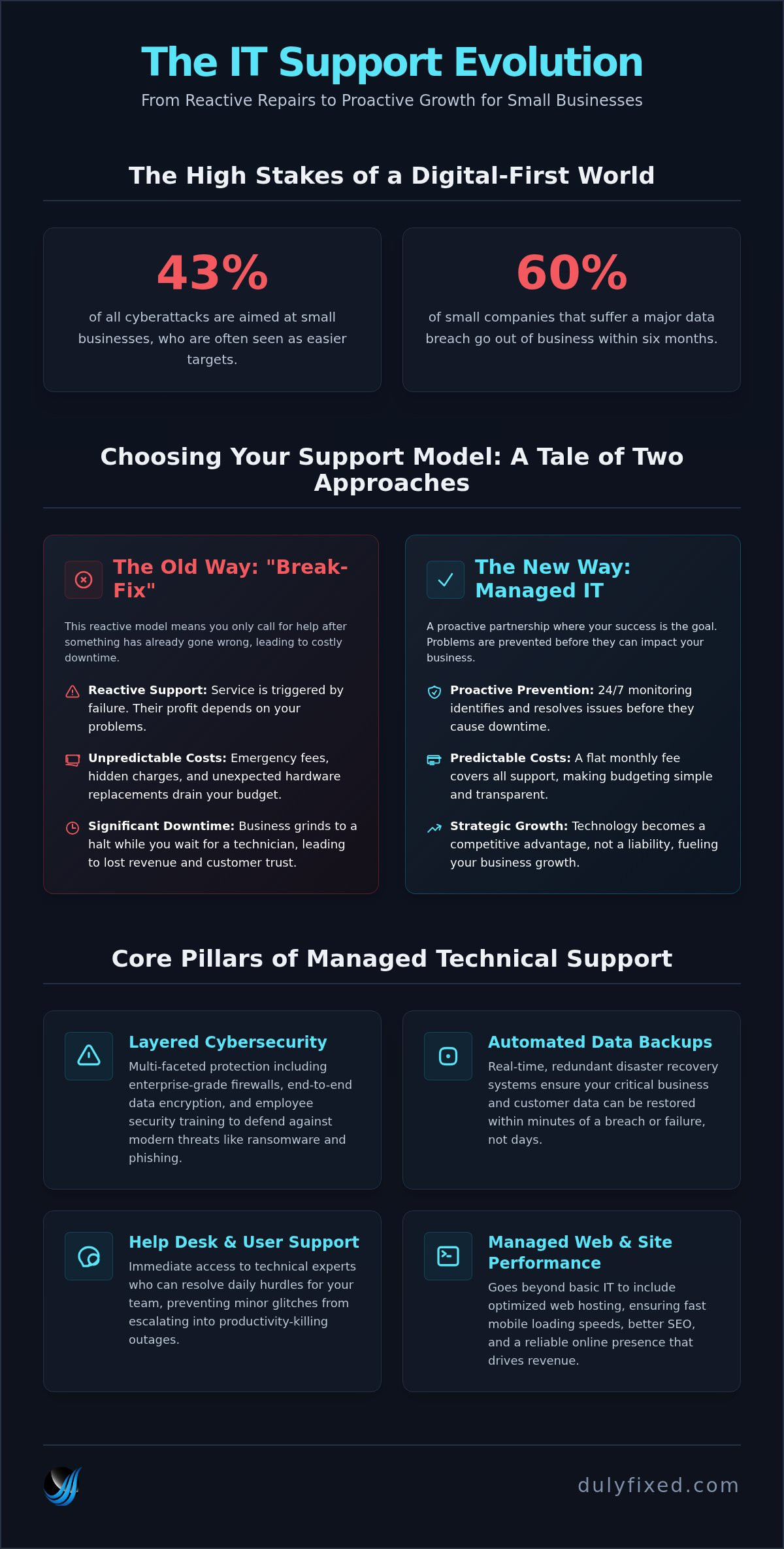
43% of all cyberattacks target small businesses, and for those that suffer a breach, 60% close their doors within six months. It's a sobering reality for local owners who are already juggling website crashes, slow loading speeds, and the unpredictable costs of "break-fix" tech help. You deserve to focus on your customers without the constant anxiety of a data breach or a failed backup hanging over your head.
Finding the right small business IT support Seattle offers is about more than just fixing a laptop. It's about building a stable foundation for growth. This 2026 FAQ guide will show you how managed technical support protects your local operation, automates your back-office tasks, and ensures your website remains a high-performing asset. We'll explore why proactive maintenance is more cost-effective than reactive repairs and how new Washington state regulations impact your digital security. From understanding the latest B&O tax reclassifications to choosing a reliable local partner, you'll get the pragmatic answers you need to move your business forward with confidence.
Key Takeaways
- Transition from reactive "break-fix" repairs to a proactive partnership that prevents downtime and website crashes before they happen.
- Understand how modern small business IT support Seattle integrates managed hosting and layered cybersecurity to safeguard your revenue and customer data.
- Compare the predictable, flat-rate costs of managed services against the high hidden expenses of emergency technical fees and lost productivity.
- Follow a two-step audit to evaluate local expertise and find a tech partner who understands the specific regulatory landscape of Washington state.
- Learn how back-office automation and mobile-first site design can turn your technical infrastructure into a powerful tool for digital growth.
What is Managed IT Support for Small Businesses?
For years, small business owners viewed technology as a "set it and forget it" expense. You bought a computer, used it until it slowed to a crawl, and called a "computer guy" when it finally gave up. That model is dead. In 2026, What is Managed IT Support has evolved into a strategic partnership. It operates on a "subscription for peace of mind" model. Your tech partner is incentivized to keep things running perfectly rather than waiting for things to break so they can bill you for repair hours.
Managed technical support is the ongoing oversight of hardware, software, and digital infrastructure. This approach moves you away from a reactive mindset and positions your technology as a tool for growth. When you invest in small business IT support Seattle companies can trust, you aren't just hiring a repairman; you're gaining a strategic advisor who understands how your back-office automation impacts your bottom line.
The Shift from Break-Fix to Proactive Support
The old "break-fix" model is inherently flawed because it relies on your failure for the provider to make money. If your system is down, they get paid. In a managed model, the goals are aligned. Proactive support uses 24/7 monitoring to catch a failing hard drive or a security vulnerability before it results in a system-wide crash. Seattle businesses can't afford the downtime that comes with waiting for a technician to show up on-site. Modern threats in 2026, from sophisticated phishing to automated ransomware, require constant updates and real-time responses that only a proactive partner can provide.
Why Seattle Small Businesses are Outsourcing Tech
Hiring a full-time IT manager in the Pacific Northwest is expensive. Between high salaries and benefits, the cost often exceeds what a small operation can sustain. Outsourcing provides a pragmatic alternative. You get access to enterprise-grade security tools and specialized software that would be cost-prohibitive for a single shop to purchase alone. Choosing the right small business IT support Seattle provider means finding a team that prioritizes your uptime over their billable hours.
This model also offers essential scalability. Whether you are operating a boutique in Seattle or managing logistics out of Soap Lake, your support needs will change as you grow. A partner like Dulyfixed ensures your technical infrastructure scales seamlessly, from your first landing page to complex back-office automation. This allows you to focus on your core business while experts handle the digital heavy lifting.
The Critical Components of Managed Technical Support
Effective small business IT support Seattle relies on a multi-layered defense and performance strategy. It isn't enough to simply have a firewall in place. A comprehensive approach integrates several critical components of managed technical support to ensure your operations remain resilient against modern threats. In 2026, the stakes are higher than ever. With 88% of small business breaches now involving ransomware, your technical foundation must be airtight.
- Layered Cybersecurity: This includes enterprise-grade firewalls, end-to-end encryption, and ongoing employee training to prevent phishing, which remains the most common entry point for local attacks.
- Automated Data Backups: Real-time disaster recovery ensures that even if a breach occurs, your data is redundant and restorable within minutes, not days.
- Help Desk Access: Immediate technical assistance for daily hurdles keeps your team productive and prevents minor glitches from turning into afternoon-long outages.
Managed Web Hosting and Site Performance
Most traditional IT shops ignore the server side of your business, but your website is often your primary revenue driver. Managed web hosting bridges the gap between technical support and digital growth. Unlike generic shared hosting, managed solutions offer dedicated resources that significantly improve mobile-first loading speeds. This is vital for SEO and user retention. If you want to see how these elements work together in practice, reviewing a website maintenance Wenatchee guide can help you understand the checklist required for peak performance.
Security and Compliance in a Digital-First Market
In Washington, compliance is no longer optional for small shops. The My Health My Data Act (MHMDA) and state data breach notification laws require businesses to notify affected individuals within 30 days of discovering a compromise. A proactive partner ensures your customer data is protected through regular security audits and SSL certificates. An SEO-ready site structure that prioritizes security builds trust with both search engines and your clients. By integrating these protections into your daily workflow, you turn technical necessity into a competitive advantage.
Stability starts with the right partner. If you are ready to move beyond reactive repairs and secure your digital future, you can connect with our team to discuss a tailored support plan for your Seattle business.
Managed Services vs. Break-Fix: A Cost-Benefit Analysis
The traditional "break-fix" approach is a gamble that rarely pays off for modern organizations. When you only pay for small business IT support Seattle when something breaks, you're essentially waiting for a disaster to occur before seeking help. This reactive cycle leads to unpredictable emergency fees, which often range from $125 to $350 per hour in the Pacific Northwest. Beyond the invoice, the true cost lies in lost productivity and missed opportunities while your team waits for a technician to arrive. Finding reliable small business IT support Seattle providers who offer fixed-rate agreements is the first step toward financial stability.
Managed services replace this volatility with a predictable monthly billing cycle. This shift allows you to treat technology as a utility rather than a series of expensive surprises. By prioritizing uptime, you ensure that your staff stays focused on billable work and your customers never encounter a slow-loading checkout page. While managed services require a consistent monthly investment, they effectively eliminate the catastrophic expenses and reputational damage associated with major system failures.
The Real Cost of Downtime
For a local retail or service provider, one hour of a non-functional website can mean thousands in lost sales. It isn't just about the immediate transaction; technical glitches erode customer trust. A user who experiences a slow or broken site is unlikely to return. Using professional landing page design helps ensure your conversion funnel remains robust, but that design only works if the underlying infrastructure is stable. Uptime is the silent driver of digital growth in Seattle's competitive market.
Budgeting for IT in 2026
Smart financial planning in 2026 involves moving IT from a Capital Expenditure (CapEx) to an Operating Expenditure (OpEx). Instead of buying expensive servers that depreciate the moment they're installed, managed services allow you to pay for what you use. This model provides significant tax benefits and frees up cash flow for other areas of your business. It also ensures you're always running the latest hardware and software without needing a massive upfront budget.
Adhering to cybersecurity best practices is much easier when the costs are baked into your monthly plan. Many Seattle small businesses are now choosing hybrid models to maintain maximum flexibility. This allows them to scale their support up or down based on seasonal demand or growth spurts. By viewing IT as a fixed operating cost, you gain the clarity needed to make long-term strategic decisions without fearing the next technical "hiccup."
How to Choose the Right Seattle IT Support Partner
Selecting the right small business IT support Seattle provider requires looking beyond basic technical skills. You need a partner who understands the high-stakes environment of the Pacific Northwest and can act as a pragmatic guide for your digital growth. This selection process should be methodical and focused on your long-term stability rather than just finding a quick fix for a broken laptop.
First, audit your current technical pain points and growth goals. Are you losing hours to slow loading speeds or manual data entry? A resourceful partner will ask about your business objectives before they ever mention hardware or software. Second, verify their local expertise in both the Seattle and Wenatchee markets. Regional nuances matter when it comes to local compliance and connectivity. Third, look for automation. In 2026, simply "fixing" things is the bare minimum; your provider should be actively streamlining your back-office tasks to save you time and reduce human error.
Fourth, examine their own digital presence. If an IT provider doesn't have a mobile-first, SEO-ready site, they aren't the right choice to manage yours. They should practice the high-performance standards they preach. Finally, demand total transparency in reporting and security protocols. You should receive clear, regular updates on system health and vulnerability patches without needing a degree in computer science to interpret the data.
Local Knowledge Matters
Accountability is the cornerstone of a successful partnership. While remote support is efficient for minor glitches, having a local partner who understands the business climate from Moses Lake to Seattle provides a level of reliability that a distant call center cannot match. It's about a resourceful "can-do" attitude. When a critical system fails, you need a tech-savvy peer who is deeply invested in providing stable, long-term solutions, not just a vendor closing a ticket.
Evaluating Technical Expertise
Ask tough questions about their managed hosting and security stack. Do they prioritize mobile-first loading speeds? How do they handle the specific 2026 security threats discussed earlier in this guide? A partner who helps you scale will also understand the value of a full-service creative tech partnership. This includes modern assets like custom music for brands and high-quality video production. These elements work in synergy with your technical infrastructure to build a professional, cohesive brand identity that attracts customers.
If you're ready to stop settling for reactive repairs and start building a stable digital foundation, reach out to us today to audit your current technical setup and discuss your growth goals.
Modernizing Your Operations with Dulyfixed Technical Support
Effective small business IT support Seattle should do more than just keep your screens on. It should actively improve how your business functions every day. At Dulyfixed Small Business Solutions, we approach technical support as a vehicle for modernization. This means looking at your entire digital ecosystem, from the way your back-office handles data to how a customer interacts with your site on a smartphone while walking down Pine Street.
By streamlining your workflows, we free you up to focus on high-level strategy rather than repetitive administrative tasks. Technology should be a silent partner that empowers your growth, not a source of constant friction. We position ourselves as your pragmatic guide, ensuring that every technical decision you make is grounded in the reality of your specific business needs and local market demands.
Beyond Fixes: Back-Office Automation
Automation is the bridge between basic IT and true operational efficiency. We integrate your existing systems to reduce manual data entry, which is often the primary source of human error and lost time. For example, connecting your lead capture forms directly to your CRM or automating your inventory updates can save your team hours of "busy work" every week. This transition turns your IT from a cost center into a significant time-saver.
- Reduced Redundancy: Stop entering the same customer data into multiple disconnected spreadsheets.
- Improved Accuracy: Automated systems don't get tired or make typos during repetitive tasks.
- Faster Turnaround: Respond to inquiries or process orders in real-time without waiting for manual intervention.
When these small business workflow improvements are implemented correctly, the return on investment becomes immediate. These tools aren't just for enterprise-level corporations. Small shops in Seattle are using these same strategies to punch above their weight class and compete with much larger organizations.
The Dulyfixed Small Business Solutions Advantage
Our commitment goes beyond standard maintenance. We specialize in mobile-first website design because that is where your customers are. An SEO-ready site structure ensures that your business remains visible in an increasingly crowded digital landscape. We focus on "human-first" value, meaning we never recommend a solution just because it's trendy. It has to work for you, your staff, and your customers.
Your technical infrastructure should be a competitive advantage, not a hurdle. If you are ready to stop fighting with your software and start scaling your operations, you should schedule a consultation to fix your tech hurdles. Let's build a foundation that supports where your business is going, not just where it is today.
Secure Your Digital Future with Strategic Support
You've seen how the old "break-fix" model drains your budget and your time. In 2026, staying competitive means moving beyond basic repairs. It requires a proactive partnership that prioritizes uptime, layered security, and back-office automation. By streamlining manual tasks and securing your server-side performance, you turn your technical infrastructure into a growth engine rather than a maintenance headache. You deserve a partner who understands the local landscape and provides accountability when it matters most.
Finding the right small business IT support Seattle is the first step toward long-term stability. At Dulyfixed, we bring decades of real-world technical experience to help small teams in Seattle, Wenatchee, and Moses Lake scale efficiently. We don't just fix hardware; we modernize operations through specialized automation and mobile-first site design. This approach ensures your business remains resilient against emerging threats while providing a seamless experience for your customers. It's time to stop fighting with your tech and start focusing on your next big move.
Ready to streamline your Seattle business? Contact Dulyfixed for pragmatic IT solutions.
Frequently Asked Questions
What is the average cost of small business IT support in Seattle?
Managed IT services in the Pacific Northwest typically cost between $100 and $250 per user per month. For a company with ten employees, this provides a predictable monthly operating expense that covers maintenance and security. In contrast, reactive "break-fix" repairs often bill between $125 and $350 per hour. Choosing a managed model eliminates the volatility of emergency invoices and ensures your systems are monitored around the clock to prevent failures.
Does my business need managed IT support if we only have three employees?
Yes, even a three-person team benefits from a managed partnership because the cost of a single data breach or a day of downtime can be devastating for a micro-business. Cybercriminals often target smaller shops precisely because they lack dedicated security. Managed support provides enterprise-grade protection and automation that allows a small team to focus on revenue-generating work rather than troubleshooting printer drivers or server glitches.
What is the difference between IT support and managed web hosting?
IT support focuses on your internal infrastructure, including hardware, local networks, and employee devices. Managed web hosting specifically handles the server environment where your website lives. While standard small business IT support Seattle keeps your office running, managed hosting ensures your site is fast, secure, and always available to customers. Dulyfixed integrates both to provide a seamless technical foundation for your entire digital operation.
Can managed technical support help with my website’s SEO?
Yes, managed technical support directly impacts SEO by optimizing server response times and ensuring mobile-first loading speeds. Search engines prioritize sites that are secure, stable, and fast. By maintaining an SEO-ready site structure and implementing SSL certificates, your tech partner helps your business rank higher. Technical support also prevents the "404 errors" and site crashes that hurt your reputation with both users and search algorithms.
How quickly should a managed IT provider respond to a critical issue?
A reliable provider should offer a guaranteed response time for critical issues, typically ranging from 15 minutes to one hour for catastrophic failures. Your service agreement should clearly define "critical" versus "non-urgent" tasks. Fast response times are essential for minimizing the financial impact of downtime. Proactive monitoring often allows a partner to resolve a server issue before your staff even notices a disruption.
What is back-office automation and how does it fit into IT support?
Back-office automation involves using software to handle repetitive administrative tasks like data entry, invoicing, and lead management. It fits into small business IT support Seattle by ensuring these automated workflows are secure, integrated, and functioning correctly. This modernization frees up your time for high-level strategy. Instead of manually syncing spreadsheets, your systems talk to each other, reducing human error and increasing your overall operational speed.
Is remote IT support as effective as on-site visits?
Remote support is highly effective for approximately 90% of technical issues, including software updates, security patches, and help desk queries. It offers a faster resolution time than waiting for a technician to drive across town. However, on-site visits remain necessary for physical hardware installations or complex network failures. A hybrid approach provides the best balance of speed and local accountability for organizations in the Seattle area.
What should be included in a standard managed services agreement (MSA)?
A standard managed services agreement should include a clear scope of work, service level agreements (SLAs) for response times, and a detailed list of security protocols. It should also outline data backup schedules and disaster recovery plans. Transparency is key. Ensure the agreement specifies what is covered by your flat monthly fee and what might incur additional project-based costs to avoid billing surprises.


