

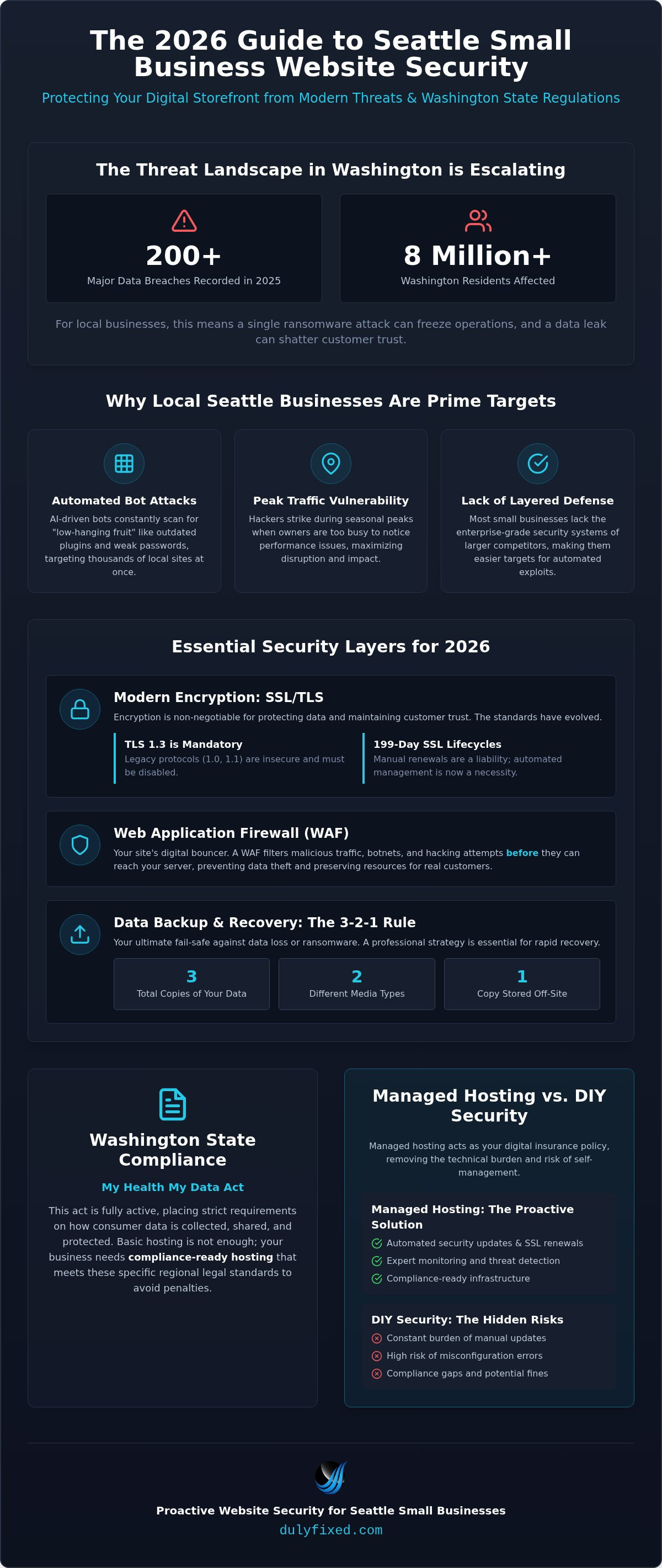
Did you know the Washington State Attorney General’s Office recorded over 200 major data breaches in 2025, affecting more than 8 million residents? For a local entrepreneur, these aren't just abstract figures. They represent the very real risk of a single ransomware attack freezing your operations or a data leak shattering the trust you've built with your community. You likely feel the weight of keeping your digital storefront safe but find yourself buried under technical jargon like EDR or WAF.
We understand that you need small business website security seattle that works in the background so you can focus on your actual work. You want a secure site that doesn't sacrifice speed or search rankings. This 2026 protection guide reveals the essential security layers required to stay compliant with the Washington My Health My Data Act and protect your bottom line. We will break down the shift to shorter SSL lifecycles, explain why managed hosting is your best insurance policy, and provide a clear roadmap to a set-it-and-forget-it security posture.
Key Takeaways
- Learn how to move your digital presence out of the "low-hanging fruit" category by addressing common vulnerabilities that attract automated bot attacks.
- Understand the critical role of modern SSL protocols and Web Application Firewalls (WAF) in maintaining local customer trust and protecting your search engine visibility.
- Discover why managed web hosting acts as a streamlined digital insurance policy for small business website security seattle, removing the technical burden of manual updates.
- Access a 2026-ready security checklist to ensure your operations comply with the Washington My Health My Data Act and other evolving state regulations.
- Identify how a proactive security posture prevents costly downtime while maintaining the fast, mobile-first performance your customers expect.
The State of Small Business Website Security in Seattle (2026)
Website security isn't a static checkbox or a one-time purchase. It's the proactive defense of your public-facing digital assets. In 2026, small business website security seattle has shifted from simple firewalls to active, AI-aware monitoring. Modern threats don't just target the tech giants in South Lake Union. Automated bots now scan thousands of local sites simultaneously, looking for "low-hanging fruit" like outdated plugins or weak administrative passwords. These bots use AI-driven brute force to guess credentials and sophisticated form-jacking to skim customer data directly from your contact or checkout pages.
Security is now tied directly to your revenue. If your site goes down or gets flagged for malware, your local search rankings won't just dip; they'll plummet. Google prioritizes user safety. A single day of downtime or a "This site may be hacked" warning can wipe out months of SEO progress. Protecting your site is no longer just an IT task. It's a fundamental part of maintaining your digital storefront's visibility and profitability.
Why Seattle Businesses Are Prime Targets
Think of the "Rare Sunbreak" effect. When the clouds finally part and Seattleites rush to book services or buy local, that's the worst possible time for a site crash. Hackers target small businesses during peak seasonal traffic because they know owners are often too busy to notice subtle performance lags. Most local shops lack the layered defense systems used by enterprise competitors, making them easier targets for automated exploits. In our tight-knit business community, reputation damage travels fast. A data breach can destroy years of customer trust in a single afternoon.
Washington State Compliance and Your Website
Washington’s regulatory environment has evolved significantly. The Washington My Health My Data Act is now fully active, placing strict requirements on how even small entities collect and share consumer information. Staying compliant requires a solid grasp of the core concepts of computer security to ensure data isn't just stored, but actively protected. There's a major difference between basic "secure hosting" and "compliance-ready hosting" that meets regional legal standards. Local insight is vital here. If you're concerned about how these laws affect your digital presence, you can find guidance through the technical support team at dulyfixed.com/contact-us.
Essential Components of a Secure Small Business Website
A secure website isn't the result of a single plugin. It's a combination of several layers working together to protect your digital storefront. For effective small business website security seattle, you must start with the basics of encryption. As of early 2026, TLS 1.3 is the mandatory industry standard for all new connections. If your site still relies on older protocols, you're leaving a door open for attackers. Additionally, new industry rules have reduced the maximum validity for SSL certificates to just 199 days. This change means manual renewals are becoming a liability. Automated management is now a necessity to avoid expired certificates that scare away local customers.
- Verify your server uses TLS 1.3 and has disabled legacy TLS 1.0 or 1.1 protocols.
- Confirm your hosting provider handles the 199-day renewal cycle automatically.
- Ensure your certificate validation level matches your business type (DV, OV, or EV).
Beyond encryption, a Web Application Firewall (WAF) acts as a digital bouncer. It filters out malicious traffic from botnets before they ever reach your server. This is especially vital for preventing form-jacking, where hackers inject code into your contact forms to steal user data. By blocking these threats at the edge, you preserve your server's resources for actual customers. Using an FTC cybersecurity checklist can help you verify if your current setup covers these fundamental bases before a breach occurs.
Data Backup and Recovery Strategies
Think of business data backup as your ultimate fail-safe. We recommend the 3-2-1 rule: maintain three copies of your data, on two different media types, with one copy stored off-site. Cloud-based backups are excellent, but they must be isolated from your live site to prevent ransomware from encrypting your backups along with your files. For a local shop owner, your Recovery Time Objective (RTO) is the maximum amount of time your business can afford to be offline before the loss of revenue and customer trust becomes irreversible. A modern backup system should allow you to restore operations in minutes, not days.
SEO-Ready and Security-First Architecture
Dulyfixed Small Business Solutions approaches every project with a security-by-design mindset. We build SEO-ready site structures that prioritize clean, efficient code. Many Seattle and Wenatchee retailers fall into the trap of using bloated themes packed with unnecessary features. Every extra line of code or unmanaged plugin is a potential entry point for a breach. By focusing on mobile-first website design, we reduce the attack surface significantly. This streamlined architecture doesn't just make your site harder to hack; it also improves load times and local SEO performance. If you're unsure if your current site structure is holding you back, you can reach out for a technical review to identify hidden vulnerabilities in your small business website security seattle strategy.
Managed Hosting vs. DIY Security: A Cost-Benefit Analysis
Many owners start with a DIY approach to save money. On paper, it looks simple. You install a few security plugins and plan to run updates every Sunday. However, the hidden cost of DIY is your most valuable asset: time. Between troubleshooting plugin conflicts and patching server vulnerabilities, you can easily lose several hours every week. This often leads to "Update Fatigue," where critical security patches are ignored because the process is too tedious or confusing. For effective small business website security seattle, this gap is where most breaches occur. If you spend your evenings acting as an amateur IT manager, you aren't spending them growing your business.
Managed hosting changes the math. Instead of reacting to problems, you invest in a system that prevents them. Automated monitoring and patching occur in the background, ensuring your site remains a fortress. It's essentially a digital insurance policy for your online presence. Following CISA guidance for small businesses, moving to managed services significantly reduces the risk of human error. The following table breaks down the practical differences between these two approaches.
| Feature | DIY Security Approach | Managed Hosting Solution |
|---|---|---|
| Security Updates | Manual; prone to being skipped. | Automated and tested background patching. |
| Threat Monitoring | Reactive; you find out after a crash. | Proactive 24/7 edge monitoring. |
| Backup Management | User-triggered; often stored on-server. | Automated, isolated, and off-site. |
| Technical Focus | You act as the IT administrator. | You focus entirely on business growth. |
At Dulyfixed Small Business Solutions, we view managed hosting as a proactive partnership. We handle the technical heavy lifting so your digital storefront remains stable and secure without you ever having to touch a line of code or decipher a server log.
The True Cost of a Website Breach
A breach is far more expensive than a monthly hosting fee. Recovery fees, lost sales during downtime, and potential legal penalties under the Washington My Health My Data Act reach thousands of dollars quickly. The silent killer, however, is the SEO loss. When Google flags a site as "hacked," it often removes it from search results entirely to protect users. Rebuilding that authority and reclaiming your local rankings can take months of expensive work. From a "fixer" perspective, staying secure is always cheaper than repairing a broken reputation in a competitive market like Seattle.
Technical Support: Your Local Safety Net
When something goes wrong, a 1-800 number for a global call center rarely provides the speed or local context you need. Having a managed technical support partner in the Pacific Northwest means working with experts who understand your specific market. Whether you are running a shop in Soap Lake, Moses Lake, or a boutique in Seattle, local expertise ensures faster response times and relevant advice. For a deeper dive into local upkeep, check out our Website Maintenance Wenatchee: The 2026 Small Business Checklist. If you're ready to stop worrying about your site's safety and start focusing on your customers, you can connect with our team for a streamlined solution.
2026 Security Checklist for Seattle Business Owners
Effective small business website security seattle requires a shift from passive observation to active maintenance. You can't assume your hosting provider handles every detail. Start by auditing your current setup to ensure it meets 2026 standards. This isn't just about technical perfection; it's about maintaining the trust of your local Pacific Northwest customers. Use the following checklist to identify immediate gaps in your defense.
- Audit your hosting features: Verify that your provider supports TLS 1.3 and handles the new 199-day SSL renewal cycle automatically. If they don't offer isolated backups, your data is at risk.
- Enforce Multi-Factor Authentication (MFA): Credential stuffing is a primary entry point for site takeovers. Require MFA for every administrative account, including your hosting panel and CMS.
- Sanitize your backend: Unused plugins and themes are massive vulnerabilities. If you don't need it, delete it. Hackers love messy backends with outdated code.
- Professional Technical Audit: Schedule a review of your landing pages to spot vulnerabilities that automated scanners often miss.
Securing the Client Intake Process
Your contact forms are often the most vulnerable part of your site. In 2026, bot-driven form-jacking is a common way to skim data before it even reaches your database. Ensure every lead magnet and intake form uses modern encryption and CAPTCHA-style protection. For local service providers, this is also a compliance issue regarding state data privacy laws. Following the Client Intake Automation in Wenatchee: The 2026 Small Business Guide helps you build a system that handles data safely. Automation doesn't just save time; it reduces the human error that often leads to accidental data exposure.
Employee Training and Awareness
Technology is only half the battle. The FBI reported that phishing and spoofing were the most frequent cybercrimes in 2025. Even worse, 85% of financial losses that year came from social engineering rather than technical exploits. Your team needs simple protocols to stay safe. Ban the use of sticky notes for passwords in the office. Instead, use a managed password vault. Encourage a culture where employees feel comfortable double-checking suspicious emails before clicking. A security-first culture in a small shop is your strongest firewall against fraud. If you're ready for a more professional approach to your small business website security seattle, you can request a security review from our team today.
Dulyfixed Small Business Solutions: Proactive Website Security for Seattle Small Businesses
Security shouldn't be a source of constant anxiety for a business owner. It should be a stable foundation that allows you to focus on growth. Dulyfixed Small Business Solutions acts as your pragmatic, local partner, bridging the gap between high-level technical requirements and the practical realities of running a shop in the Pacific Northwest. We don't just sell services; we provide a "fixer" approach to small business website security seattle. Our integrated model combines managed web hosting, dedicated technical support, and SEO-ready site structures into a single, streamlined solution. By handling the maintenance in the background, we ensure your digital storefront remains fast, visible, and protected.
Our philosophy centers on a mobile-first website design. This isn't just about aesthetics or user experience; it's a pillar of modern security. Lightweight, mobile-optimized sites use cleaner code with fewer bloated plugins. This reduced complexity shrinks your attack surface, making it harder for automated bots to find a way in. When you pair this efficient architecture with our proactive monitoring, you get a website that doesn't just look professional but operates with enterprise-grade stability. It's time to move from "hoping for the best" to a strategy that actively guards your reputation and search rankings.
Why Choose a Local Seattle-Area Partner?
Working with a local team means your technical support understands the specific PNW business climate. We serve neighbors in Seattle, Soap Lake, Moses Lake, and Wenatchee, providing personalized service that a global corporation simply can't match. You get direct access to experts who know your site inside and out without the corporate fluff or 1-800 wait times. This local connection ensures that your digital assets are managed by people invested in the community's success. If you're looking to upgrade your presence, we offer professional landing page design services in Soap Lake and Seattle that prioritize security from the very first line of code.
Next Steps: Securing Your Digital Storefront
The first step toward peace of mind is a baseline security audit. Dulyfixed Small Business Solutions reviews your current landing pages and hosting environment to identify immediate vulnerabilities. From there, the onboarding process for our managed hosting is designed to be seamless. We handle the migration, implement core security protocols, and set up automated backups. This transition moves the technical burden off your plate and onto ours. Don't wait for a breach to realize your site was vulnerable. You can contact Dulyfixed Small Business Solutions for a security consultation today to ensure your digital presence is ready for 2026 and beyond.
Future-Proof Your Digital Presence
Website security in 2026 is no longer a luxury or a task you can handle on your own during off-hours. It's a continuous, proactive process that directly impacts your search rankings and customer trust. By implementing automated protocols like TLS 1.3 and maintaining a mobile-first architecture, you're doing more than just stopping bots. You're building a stable foundation for growth that respects Washington state’s evolving data laws. Moving away from the DIY struggle allows you to reclaim your time while ensuring your storefront remains a fortress.
Professional small business website security seattle is about having a local partner who understands the specific risks of our regional market. Whether you're operating in Wenatchee or downtown Seattle, having a "fixer" in your corner means your site stays fast, secure, and ready for business. You don't have to navigate these technical hurdles alone. Expert managed hosting with integrated security and local PNW technical support is just one step away.
Secure your Seattle business with a Dulyfixed managed hosting plan today.
Taking action now prevents the high cost of a reputation repair later. We're here to help you build a secure, high-performing digital future.
Frequently Asked Questions
What is the most common website security threat for Seattle small businesses?
Automated bot attacks are the most frequent threat facing local digital storefronts. These scripts scan thousands of sites simultaneously to find outdated software or weak credentials. While social engineering like phishing is common, from a technical standpoint, brute force attacks on administrative logins remain a top concern. Implementing multi-factor authentication is the most effective way to stop these automated scripts before they compromise your site and sensitive customer data.
Does my small business really need a Web Application Firewall (WAF)?
Yes, a WAF is essential because it filters malicious traffic at the edge before it reaches your server. It specifically targets threats like SQL injection and cross-site scripting that standard antivirus software might miss. For a company invested in small business website security seattle, a WAF acts as a digital bouncer. It keeps your site running smoothly by blocking bot traffic that would otherwise drain your server resources and slow down your customers.
How often should I back up my business website data?
You should back up your website data at least once every 24 hours. If you run a busy e-commerce shop or collect lead data frequently, real-time backups are a better choice. Following the 3-2-1 rule ensures that even if one copy is compromised by ransomware, you have isolated versions ready for restoration. Automated, off-site backups are the best way to ensure you can recover your operations in minutes rather than days.
Will adding security features slow down my website's loading speed?
Modern security features usually improve performance rather than hindering it. A properly configured WAF can actually speed up your site by filtering out heavy bot traffic and using a Content Delivery Network (CDN) to serve files faster. Dulyfixed focuses on mobile-first website design, which ensures that security protocols are integrated into a lightweight structure. This approach prevents the "bloat" that typically causes slow loading times on older, poorly maintained sites.
What should I do immediately if I think my business website has been hacked?
First, take the site offline or into maintenance mode to prevent further data loss. Change all administrative passwords immediately and notify your hosting provider or technical support team. You must also check your most recent "clean" backup for restoration. Under the Washington My Health My Data Act, you may also have specific legal obligations to report the breach if consumer data was exposed. Contacting a professional fixer can help you identify the entry point.
Is managed hosting worth the cost for a micro-business in Seattle?
Managed hosting is a strategic investment for any business that relies on its digital presence. For a micro-business, the time saved on manual updates and security patches often outweighs the monthly cost. It provides a "set it and forget it" solution that includes professional monitoring and automated backups. This proactive approach prevents the devastating financial and SEO losses that follow a major security breach, making it a reliable form of digital insurance.
How does website security affect my local SEO rankings in 2026?
Search engines like Google prioritize user safety above all else. If your site lacks an SSL certificate or is flagged for malware, your rankings will drop instantly. In 2026, small business website security seattle is a core ranking factor. A secure, fast-loading site signals to search algorithms that your business is legitimate and trustworthy. Conversely, a single security warning can wipe out years of local SEO progress and drive customers to your competitors.


